Crushing the Line: A Beginner’s Guide to the World of RC Crawling
If you love RC cars, you already know the thrill of a high-speed bash or a perfect drift. But if you’re looking to unlock a whole new level of skill, you have to check out the world of crawling. This is where speed takes a backseat to pure, technical mastery, and “clutch” moments happen every single inch.
Imagine driving a miniature SUV up a mountain of jagged rocks, through a mud pit, or over a fallen log with total control. It’s basically the “Pro Mode” of the RC world—satisfying, high-stakes, and low-key one of the best ways to spend an afternoon with a remote in your hand.
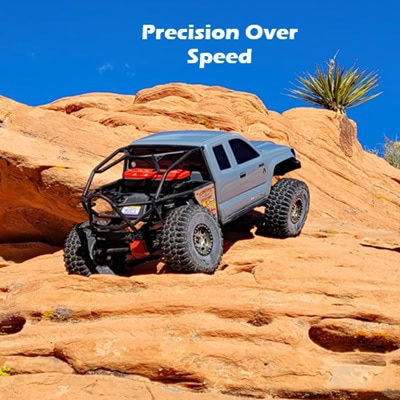
Precision Over Speed: The Strategy of the Line
In most RC hobbies, it’s all about the throttle. In crawling, it’s all about finesse. Instead of just flying over obstacles, you get to actually “read” the terrain.
You’re looking for “the line”—that perfect, clever path where your tires grab the rock and pull you up. It’s like solving a 3D puzzle in real-time. When you finally clear a vertical ledge that looks impossible? That feeling of accomplishment is a massive flex.
Gearhead Bit: To get that ultra-smooth control, pros use High-Torque Brushed Motors (like a 35T or 55T) or Sensored Brushless Systems. This tech gives you “low-end grunt,” allowing your truck to move at a snail’s pace without any stuttering (that jerky movement known as cogging). It’s all about that butter-smooth power delivery.
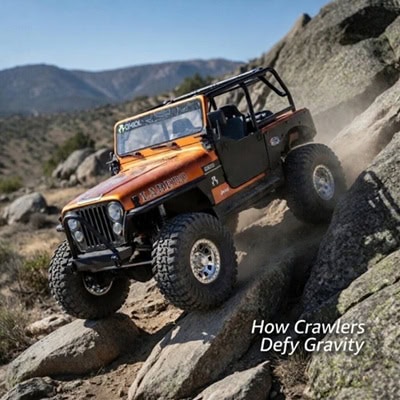
Advanced Technology: How Crawlers Defy Gravity
The rigs used for crawling aren’t your average toy store trucks. These things are engineered like beastly rock buggies:
The Drag Brake: This is a literal game-changer. On a normal RC car, if you let go of the gas on a hill, you roll back. On a crawler, the motor locks the wheels instantly. You can literally hang off a cliffside and stay there.
Suspension Articulation: This is just a fancy word for how much the wheels can move. A good crawler uses 4-link suspension geometry to let the axles twist while keeping the chassis stable.
Portal Axles vs. Straight Axles: Many top-tier rigs use Portal Axles, which have extra gears at the wheels to lift the center pumpkin (the differential) higher off the ground. More clearance = fewer stuck moments.
Choosing Your Size: 1/10 Scale vs. Micro Crawlers
There are two main ways to get into this:
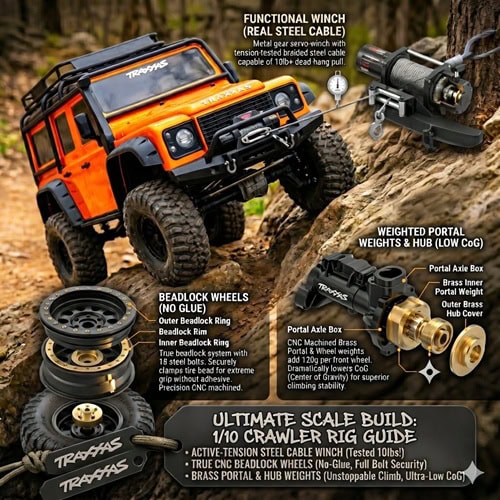
The 1/10 Scale Beasts: These are the big boys (like the Traxxas TRX-4 or Axial SCX10). They use 1.9″ or 2.2″ beadlock wheels, which actually bolt the tire to the rim so they don’t spin off when you’re pinned against a rock.
The Micros (1/18 & 1/24): These use tiny 0.7″ or 1.0″ tires. They are perfect for “Indoor Crawling” where you turn your bedroom floor, some books, and a few pillows into a hardcore obstacle course.

Scale Realism: Making it Look Authentic
Half the fun of crawling is the “Scale” look. We’re talking:
Functional Winches: Real steel cables that can actually pull a 10lb truck up a ledge.
Beadlock Wheels: Real bolts, no glue.
Weighted Wheels: Pros often add Brass Weights to the front portals or wheels to keep the Center of Gravity (CoG) low, preventing the truck from flipping backward on steep climbs.
- Browse RC Crawler Accesories
Is RC Crawling Right for You?
If you like building things, solving puzzles, and hanging out outdoors, then yes. It’s way more chill than racing, but the community is huge. Plus, there’s nothing more satisfying than watching your suspension work overtime as you conquer a terrain that would wreck any other RC car.
So, next time you see a pile of rocks, don’t just walk over them. Crawl them.
Best Places for RC Crawling in South Jersey
If you’re looking to test your rig’s suspension around Cinnaminson, we recommend checking out the rocky terrain at Palmyra Nature Cove or the trails in Pennypacker Park. For a controlled environment with expert advice, stop by our outdoor area at RC Car World.