
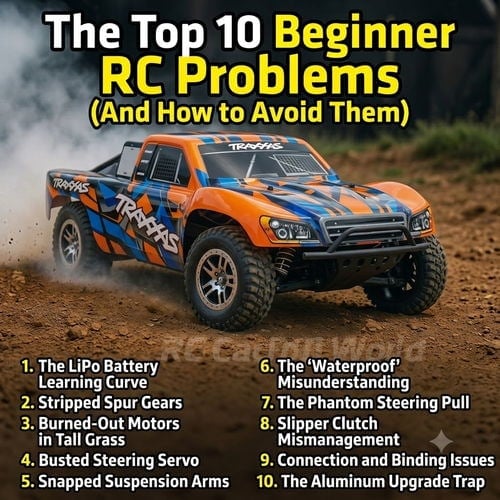
The Top 10 Beginner RC Problems (And How to Avoid Them)
Welcome to the big leagues! Making the jump from a toy store RC car to a true hobby-grade machine from brands like Traxxas, Arrma, or Losi is an absolute thrill. These vehicles are incredibly fast, highly tunable, and fully repairable.
But with that power comes a bit of a learning curve. Here at RC Car World in Cinnaminson, we’ve spent over a decade helping drivers get the most out of their vehicles. Over the years, we’ve noticed that almost every new driver runs into the exact same roadblocks.
Whether you just unboxed your first crawler or a high-speed basher, here are the top 10 most common beginner problems—and how to keep your rig out of the repair stand and on the track.
1. The LiPo Battery Learning Curve
Lithium-Polymer (LiPo) batteries offer massive power, but they require respect. The most common mistake we see is drivers running the car until it completely stops, ignoring the ESC’s Low Voltage Detection (LVD). This overdischarges the LiPo and permanently kills it.
The Fix: Stop driving as soon as you notice a dip in power, use the correct balance charging mode, and always put your batteries into “Storage Mode” if you aren’t going to drive again within a few days.
2. Stripped Spur Gears
If your motor is screaming but the truck is barely inching forward, you’ve likely stripped the plastic spur gear. This usually happens for two reasons: the “gear mesh” (the gap between the motor’s metal pinion gear and the plastic spur gear) was set too loose, or the driver landed a massive jump while still holding the throttle wide open.
The Fix: Let off the throttle while your car is in the air, and learn the “paper trick” to set a perfect gear mesh.
3. Burned-Out Motors in Tall Grass
It’s tempting to take your new 4×4 straight into thick grass or heavy mud. However, tall grass acts like a giant brake dragging on the chassis. This puts extreme stress on the motor and Electronic Speed Control (ESC), causing them to rapidly overheat.
The Fix: If you plan to run in thick grass or mud regularly, drop your pinion gear size down a few teeth to give the motor more leverage and keep temperatures in check.
4. Busted Steering Servos
When a front wheel takes a hard, direct impact with a curb or a tree, that kinetic energy travels straight up the steering linkage into the servo. If your vehicle’s “servo saver” isn’t adjusted correctly, the tiny internal gears inside the steering servo will shear completely smooth. Your car will drive forward perfectly, but refuse to turn.
The Fix: Ensure your servo saver is functioning, and if you do strip a servo, consider upgrading to one with metal internal gears.
5. Snapped Suspension Arms
Lower suspension arms are the most frequently purchased replacement parts in our shop. When you are still mastering throttle control, high-speed collisions are just part of the hobby. It’s also worth noting that the cold winter weather here in New Jersey makes plastic parts much more brittle and prone to snapping.
The Fix: Keep a few spare A-arms in your pit box, especially during the colder months!
6. The “Waterproof” Misunderstanding
Many top retail brands advertise their electronics as waterproof, and while you can absolutely splash through puddles, the entire vehicle isn’t immune to water. If you blast your car with a hose or submerge it without proper aftercare, the metal bearings, hinge pins, and screws will rust and seize up within days.
The Fix: After a wet run, use an air compressor to blow the chassis completely dry, and apply a light lubricant (like WD-40 or a specialized RC spray) to the metal hardware and bearings.
7. The Phantom Steering Pull
“My brand new car is broken—it won’t drive straight!” We hear this almost daily. In 99% of cases, the car isn’t broken at all; the driver accidentally bumped the “Steering Trim” knob on the transmitter.
The Fix: Simply twist the steering trim dial on your remote until the car tracks perfectly straight again.
8. Slipper Clutch Mismanagement
The slipper clutch is a mechanical safety feature designed to slip under heavy loads, protecting the transmission gears. If it loosens up over time, your car will sound like it has a slipping transmission and will barely accelerate. If you crank it down as tight as it goes, you remove the safety buffer, meaning the next hard impact will snap a driveshaft.
The Fix: Check your manual for the factory setting (usually tightening the nut fully, then backing it off half a turn).
9. Connection and Binding Issues
If your remote won’t connect to your car, don’t panic. The most common culprit is simply dead AA batteries in the transmitter.
The Fix: Always turn your transmitter on first before powering up the car, and turn the transmitter off last when you are done. If you still have no connection, consult your manual on how to re-bind the receiver to the remote.
10. The Aluminum Upgrade Trap
When a beginner breaks a plastic part, their first instinct is to replace it with an aluminum version so it “never breaks again.” But in RC, energy has to go somewhere. Plastic is designed to flex and absorb impacts. If you bolt on a rigid aluminum suspension arm, the force of your next crash will bypass the arm and break the chassis or bend the hinge pins—which are much harder and more expensive to repair.
The Fix: Keep aluminum parts limited to structural components like shock towers or steering hubs, but leave the suspension arms plastic so they can act as a cheap, easy-to-replace fuse!
Need replacement parts or some hands-on advice? Stop by RC Car World! As an authorized reseller for the best brands in the business, we carry the parts you need to get back up and running. Bring your rig in, and we’ll help you diagnose the issue and get you back on the track in no time.