

How to Clean & Maintain Your RC After a Muddy Run
There’s nothing better than ripping through mud, puddles, and dirt — until you’re left holding a caked-up RC and wondering where to start. A muddy run is hard on your rig, and what you do in the next 30 minutes decides whether it lasts years or dies an early death. Here’s exactly how we clean ours at RC Car World.
Why it matters
Mud holds moisture, and moisture is the enemy. Left overnight, it rusts bearings, corrodes electrical contacts, grinds down gears, and seizes moving parts. Even a “waterproof” truck is only water-resistant — the seals keep water out of the electronics, but everything else (bearings, motor, drivetrain) still needs attention.
What you’ll need
- Soft brushes (an old toothbrush + a paint brush)
- Compressed air, a canned-air duster, or a small leaf blower
Microfiber towels - RC-safe cleaner or a little dish soap + water
- Light oil and bearing/diff grease for re-lube lubes
- A few spare screws and replacement parts on hand KNKARM006
Step 1: Power down and pull the battery
Turn everything off and remove the battery first — always. Disconnect it and set it somewhere dry.
Never clean around a connected battery or ESC.
Step 2: Knock off the big stuff — dry
Let heavy mud dry slightly, then brush and tap it off. Removing the bulk before adding any water keeps you from turning dirt into a paste that gets pushed deeper into the chassis.
Step 3: Brush and wipe
With a damp (not soaking) brush and cloth, clean the chassis, body, and suspension.
A little soapy water is fine on plastic and metal — just keep water away from the motor, ESC, receiver, and servo, even on waterproof rigs.
Step 4: Blow it out
Use compressed air or a leaf blower to clear mud and water from tight spots — around the motor, ESC, servo, suspension arms, and drivetrain.
This is the single most important step for getting moisture out.
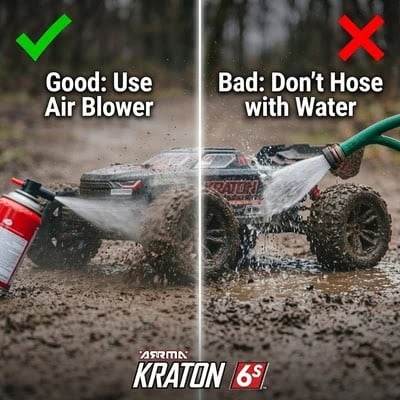
Step 5: Don’t drown the electronics
If your electronics aren’t sealed, wipe them with only a barely-damp cloth. If you ran a waterproof truck through deep water, pop any drain plugs and let it air out.
Never submerge or hose down electronics.
Step 6: Check the drivetrain and bearings
Mud loves bearings and gears. Spin the wheels — grinding or roughness means dirt got in.
Clean and re-grease the diffs and bearings; replace any bearing that won’t spin freely. bearings
Step 7: Dry completely, then re-lube
Let everything dry fully (a few hours, or overnight). Then add a drop of light oil to bearings and pivot points and fresh grease where it belongs. This is what prevents rust and keeps it smooth.
Step 8: Inspect and tighten
Go over every screw — mud runs shake things loose. Check tires for separation, look for cracked parts, and make sure the body and battery strap are secure.
Pro tips from the shop
Salt water or beach sand? Rinse and dry immediately — salt corrodes fast.
Keep a “post-run kit” in your bag: brush, towel, air duster, spare screws.
Re-grease diffs every few muddy runs, not just when something feels off.
When to bring it in
If you find a stripped gear, a bearing that won’t spin, water that got into the receiver, or anything that just feels “off” — bring it to us.
Our techs can clean, diagnose, and rebuild it right. repair servcies
Need brushes, bearings, grease, or replacement parts? We stock it all. shop online—or stop by the shop, and we’ll point you to exactly what you need.
Love the ARRMA Kraton 6S above? $829.99
Get yours HERE