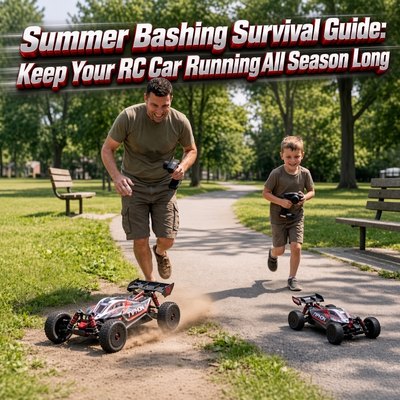
Summer Bashing Survival Guide:
Keep Your RC Car Running All Season Long
Summer is prime time for RC. Long evenings, dry trails, empty parking lots, and the whole family looking for an excuse to get outside — it’s the best three months of the year to run your rig hard. But heat, dust, and hot asphalt are also the fastest way to cook a motor or strip a gear if you’re not paying attention.
Here’s how to get the most out of your summer season and keep your car on the track instead of on the bench.
Heat Is the Enemy — Especially for Brushless Setups
Your RC electronics were built to run warm, not hot. On a 90-degree day, that hot parking lot is radiating even more heat straight up into your chassis, and a brushless motor pushing hard can climb into danger territory fast.
A few simple habits go a long way:
- Do the finger test. After a couple of runs, carefully touch the motor and ESC. If you can’t hold your finger on it for a few seconds, it’s too hot. Let it cool before you send it again.
- Give it rest between packs. Swapping in a fresh battery? Give the motor five minutes to breathe first. Back-to-back hard runs with no cooldown is how motors get retired early.
- Watch your gearing. Over-gearing (too big a pinion) makes your motor work harder and run hotter. If you’re running higher temps than usual, dropping a tooth or two on the pinion can save your motor.
- Keep it out of direct sun. Don’t leave your car — or your batteries — baking on the ground between runs. A shady spot or a cooler makes a real difference.
If your car ever shuts down mid-run and won’t restart, that’s often your ESC’s thermal protection kicking in. That’s a good thing — it’s saving your electronics. Let everything cool down completely before you try again.

Battery Care When It’s Hot Out
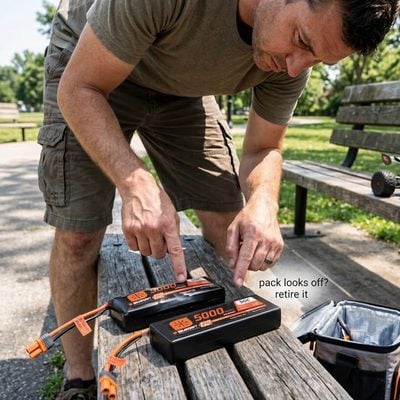
LiPo batteries and heat do not mix. A hot pack is a stressed pack, and a stressed pack loses life fast.
- Never charge a hot battery. Let it cool to room temperature first. Charging a warm LiPo shortens its lifespan and, in the worst case, is genuinely dangerous.
- Store and transport them cool. A small cooler (no ice directly touching the packs) is perfect for a day at the track.
- Don’t run them all the way flat. Deep-discharging a LiPo in the heat is doubly hard on it. When the car noticeably slows down, you’re done — swap packs.
- Puffed pack? Retire it. If a battery is swollen or feels soft, stop using it. Summer heat makes marginal packs fail faster.
Dust, Dirt, and the Great Outdoors
Summer running means summer grime. Dust is sneaky — it works its way into bearings, gears, and moving parts and grinds away at them every run.
After a dusty session, take five minutes to knock the big stuff off with a soft brush or a quick blast of compressed air. Pay special attention to:
- Bearings — grit here means rough, slow, noisy running.
- The gear differential and drivetrain — dirt in the gears accelerates wear.
- The slipper clutch and pinion/spur mesh — debris here can throw off your gear mesh.
If you run near sand or fine dust regularly, it’s worth pulling the gearbox once a season for a proper cleaning. It’s a small job that heads off a big one.
The Pre-Run Checklist That Saves Your Weekend
Ninety percent of “my car broke” moments trace back to something that was loose or worn before the run. Sixty seconds of checking beats an hour of fixing:
- Wheel nuts — snug, all four.
- Suspension and steering — no loose or cracked parts, nothing binding.
- Battery connection — clean and tight.
- Screws — vibration backs them out; a quick once-over catches the loose ones.
- Tires — check for worn-through spots or tires coming unglued from the rims (heat softens tire glue).
When Something Does Break
Even with perfect care, summer running is hard on hardware — that’s part of the fun. The most common warm-weather casualties are stripped gears, worn bearings, cooked motors, and torn tires. The good news is these are almost always straightforward fixes, and getting back on the track is usually just a matter of the right part.
If you’re not sure what broke — the car powers on but won’t move, or it moves but sounds wrong — start with the basics: check the battery, then listen for whether the motor is spinning. From there it’s usually the gears, the servo, or the driveline. When in doubt, bring it in or send us a photo. Diagnosing a dead rig is exactly the kind of thing we do all day.
Get Out There
Summer doesn’t last forever, so don’t spend it on the bench. Run smart, keep your car cool, knock the dust off, and check your hardware — and you’ll get a full season of driving out of your rig instead of a full season of repairs.
Need parts, a fresh battery, or a hand figuring out what went wrong? Stop by the shop or reach out — we’ll get you back out there before the good weather’s gone.